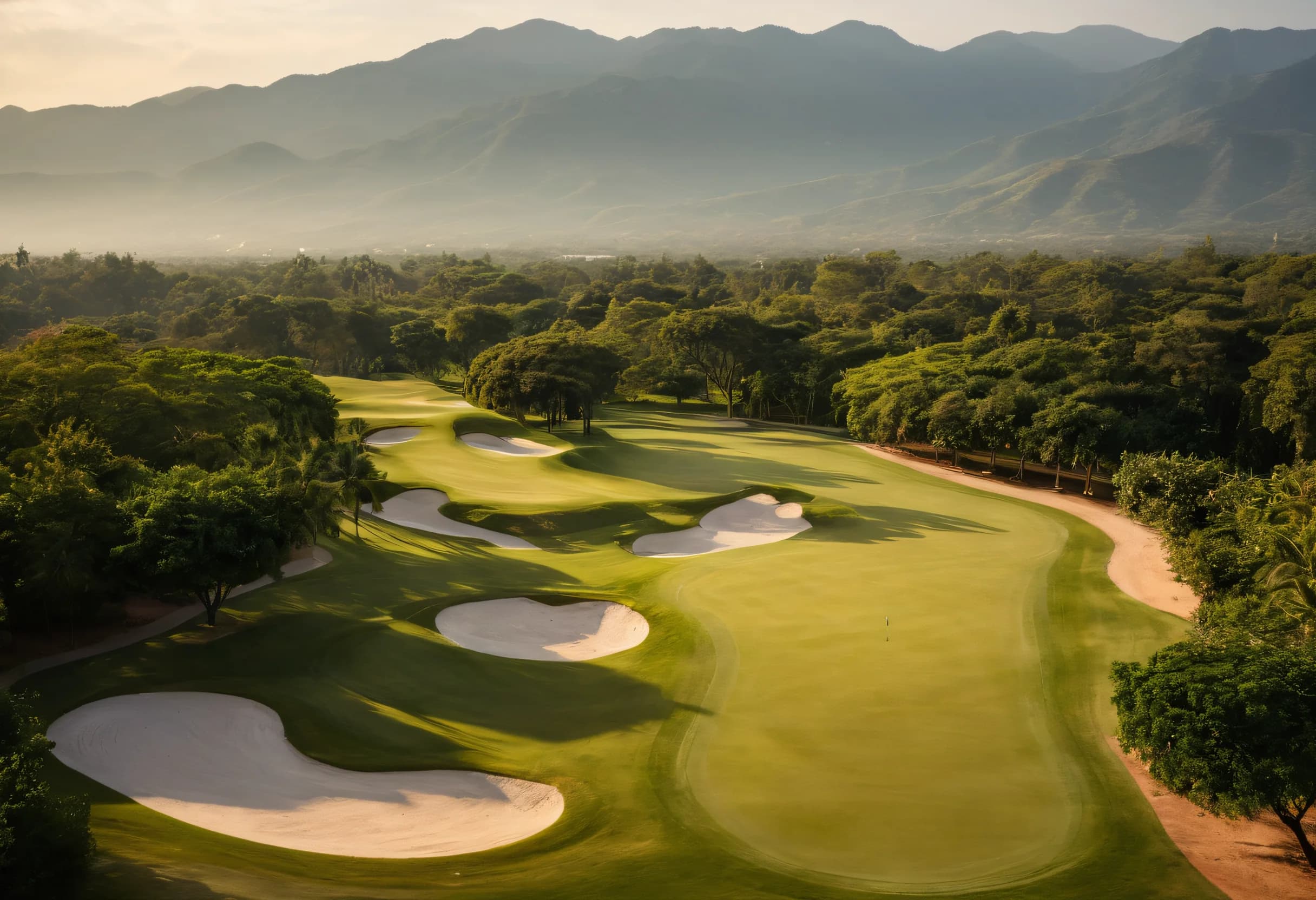
Altitude adds only about 1% to your ball flight in Chiang Mai, because the city sits at roughly 313 metres. That works out to about 3 yards on a 250-yard drive. Temperature swings between seasons change carry by around three times as much, and the raised tees on hilly courses matter more than either. Here is how to adjust your yardages hole by hole.
Does altitude affect golf ball distance in Chiang Mai?
Slightly. At about 313 metres above sea level, thinner air adds roughly 1% carry, which is around 3 yards on a 250-yard drive.
Chiang Mai sits in the Ping River valley at about 313 metres, according to WorldAtlas (accessed 2026-10-09). That is close to 1,030 feet. The usual golf rule is "2% per 1,000 feet", but MyGolfSpy's review of the testing (accessed 2026-10-09) calls that figure a bit strong. It puts the real range at about 1.1 to 1.6% per 1,000 feet and uses 1.2% in its chart.
Apply that 1.2% rate to Chiang Mai's 1,030 feet and the gain comes out at about 1.2%. Compare that with Denver at 5,280 feet, where the same method gives about 6%. Chiang Mai is a hill-country destination, but the courses sit near the valley floor, not up on the peaks. The mountains around the valley reach 2,565 metres at Doi Inthanon, and no course we book is anywhere near that height.
How many extra yards will I gain per club?
Very few. Expect about 3 extra yards with the driver, 2 with mid-irons and 1 with wedges, because altitude works as a percentage of carry.
The altitude gain is a percentage, so long clubs gain more yards than short ones. MyGolfSpy also notes that these are carry figures, not total distance. Roll depends on turf, which we cover further down.
| Club | Sea-level carry | Approx. carry at Chiang Mai (313 m) | Gain |
|---|---|---|---|
| Driver | 250 yd | 253 yd | +3 yd |
| 3-wood | 225 yd | 228 yd | +3 yd |
| 7-iron | 150 yd | 152 yd | +2 yd |
| 9-iron | 125 yd | 126 yd | +1 yd |
| Pitching wedge | 110 yd | 111 yd | +1 yd |
For most amateurs, 2 yards with a 7-iron is smaller than normal strike-to-strike variation. Do not rebuild your bag numbers for the altitude. The bigger factors are below.
Does heat matter more than altitude here?
Yes, about three times more. Driver carry shifts roughly 2.5 yards per 10F, and Chiang Mai's seasons span around 35F of temperature difference.
Andrew Rice's TrackMan study, reported by Golf.com (accessed 2026-10-09), found driver carry changes by about 2.5 yards for every 10 degrees Fahrenheit, at a 155 mph ball speed. The effect is smaller for short clubs: about 1.3 yards per 10F with a pitching wedge.
Now look at the local temperatures. On cool-season mornings, the higher courses often start somewhere around 15 to 22C. In the hot season from March to May, afternoons regularly pass 35C. Going from 15C to 35C is a 36F swing. On Rice's numbers, that is roughly 9 yards of driver carry.
Does Chiang Mai's humidity shorten my shots?
Hardly at all. TrackMan data shows humidity has almost no effect on carry. Wet turf in the green season is what costs you distance.
Rice found humidity had "almost no effect" on carry. Humid air is actually a little less dense than dry air, so the tiny effect it does have works in your favour.
The real loss in the green season (June to October, usually wettest in August and September) happens on the ground. After an afternoon storm, fairways go soft and a drive that would run out in February stops close to where it lands. Mornings are usually playable, but expect to lose most of your roll. Our green conditions guide covers how putting surfaces change across the year.
How should I play raised tees and uphill approaches?
Treat slope as the main adjustment. A raised tee or an uphill green changes playing distance more than all the atmospheric factors put together.
This is where hilly northern courses actually test your club selection. Caddies commonly work on a rough rule of thumb: add or take away about one yard for every yard of rise or drop on approach shots. It is a starting point, not physics. Wind and your own ball flight change it, and a high-spin player will see more effect than a low-ball hitter.
The courses with the most noticeable elevation play among those we book:
- Alpine Golf Resort: a Ron Garl design with rolling terrain, raised tees and one of the longest par-5s you will play in the north. Read our Alpine Golf Resort review.
- Chiangmai Highlands Golf and Spa: a Lee Schmidt design with 27 holes, heavy bunkering and some of the most consistent conditioning in the region.
- Gassan Khuntan: dramatic mountain scenery, but it is the furthest transfer at 45 minutes or more, and conditioning is usually behind the other Gassan courses.
Which Chiang Mai courses play flattest?
Gassan Legacy, Royal Chiang Mai and the city-edge courses play flattest, so your stock yardages hold up best there.
If you want your numbers to behave like home, pick a flatter layout. Gassan Legacy is the flattest and easiest of the Gassan courses, at around 6,850 yards and roughly ฿1,950 all-in by day for Apr-Oct 2026 (CMGT Golf, 2026; we confirm the live rate in every quote). Royal Chiang Mai, a Peter Thomson design, plays British-links style with pot bunkers and run-offs. It tests bump-and-run judgment more than elevation. Conditioning there is mixed, so do not expect Highlands-grade greens.
Close to town, Lanna Golf Club is about 10 minutes from the Old City and allows walking, which is rare in Thailand. It suits a short warm-up round on arrival day, when you want to check your stock yardages before the hill courses. Our Chiang Mai golf holidays team can help you compare layouts and pick the right mix.
When do Chiang Mai yardages change most during the year?
Between the cool January mornings and the hot March to May afternoons. The air is thinnest and the ball flies furthest at the hottest time of year.
| Period | Typical conditions | Carry effect vs. cool mornings | Ground game |
|---|---|---|---|
| Nov-Feb (cool, dry) | Cool mornings, warm afternoons | Baseline | Firm, good roll |
| Mar-May (hot) | 35C and above | Up to about 9 yd more with driver | Firm, but haze and smoke |
| Jun-Oct (green season) | Humid, afternoon storms | Small gain from warmth | Soft, little roll |
The honest downside: the season where the ball flies furthest is also the worst time to play. Burning season smoke usually builds from around February, peaks in March and clears in April as the rains approach. On the worst days PM2.5 readings reach hazardous levels, and Chiang Mai has ranked among the most polluted cities in the world. A few extra yards are not worth a round in that air. Read our burning season golf guide and the best time for golf in Chiang Mai before you pick dates.
Will the heat cost me distance over 18 holes?
Often, yes. Hot air adds carry, but fatigue on the back nine can cut swing speed by more than the heat gives you.
Heat helps the ball, not the golfer. On a 32C afternoon with high humidity, many of our guests find their back-nine drives shorter than their front-nine ones, even though the air is warmer. Book early tee times, drink more water than you think you need, and use the cart shade between shots. Our beat-the-heat guide and heat prep guide cover the details.
How do we plan rounds around these factors?
We schedule cooler morning tee times, mix hilly and flat layouts, and brief you on each course's elevation quirks before you tee off.
When we build a trip, we put the hilly courses early in the day and save a flatter course for the round after a long travel day. A typical pairing is Highlands and Alpine for the elevation test, plus Gassan Legacy or Royal Chiang Mai for a stock-yardage day. The Highlands Classic package follows this pattern over 5 nights and 4 rounds.
The all-in package covers green fees, caddies, carts, hotel, a private driver and airport transfers, with on-the-ground support. For a single round, booking direct can work out cheaper, and we will tell you that. Over three or more rounds across courses 30 to 45 minutes out of town, private transfers and tee-time handling usually make the package worth it. We are enquiry-driven: you send your dates, we send a quote, then we confirm with a deposit. Start on our Chiang Mai golf holidays page.
Plan a Chiang Mai golf trip that fits your gameTell us your dates and handicap. We reply with a tailored quote.Frequently asked questions
Does altitude affect golf ball distance in Chiang Mai?
Yes, but only a little. Chiang Mai city sits about 313 metres (roughly 1,030 feet) above sea level. Testing summarised by MyGolfSpy puts the carry gain at about 1.1 to 1.6% per 1,000 feet, so you gain around 1% here. On a 250-yard drive that is about 3 yards, and on a 150-yard 7-iron about 2 yards. Most golfers will not notice it inside normal shot-to-shot variation. Temperature and slopes on individual holes change your numbers far more than the valley's altitude does.
Should I club down when playing golf in Chiang Mai?
Not for altitude alone. A 1% gain rarely justifies a full club change. Where you should adjust is heat and slope. A hot afternoon in April can add several yards of carry compared with a cool January morning, and the raised tees and uphill approaches on courses like Alpine and Highlands change effective yardage more than the air does. Ask your caddie for the playing distance, not just the marker distance. They walk these holes every day and usually factor in the slope.
Does heat make the golf ball go further in Thailand?
Yes. Warm air is less dense, so the ball meets less drag. Andrew Rice's TrackMan study, reported by Golf.com, found driver carry changes by about 2.5 yards for every 10 degrees Fahrenheit. A swing from a 15C cool-season morning to a 35C hot-season afternoon is about 36F, which works out to roughly 9 yards of driver carry. That is about three times the altitude effect. The trade-off is fatigue: your swing speed may drop late in a hot round, which cancels out some of the gain.
Does humidity in Chiang Mai shorten my shots?
Barely. Rice's TrackMan data found humidity had almost no effect on carry. Humid air is actually slightly less dense than dry air, so the physics tilts very slightly in your favour. What does cost you distance in the green season (June to October) is wet turf. Soft fairways after afternoon storms take away roll, and a ball that would run out well in the dry season can stop close to where it lands. Plan on carry numbers, not total distance, from July onwards.
Which Chiang Mai courses have the biggest elevation changes?
Alpine Golf Resort and Chiangmai Highlands Golf and Spa have the most noticeable elevation changes among the courses we book, with raised tees and approach shots that play up or down a level. Gassan Khuntan has dramatic mountain scenery but is the furthest transfer, 45 minutes or more. Flatter options include Gassan Legacy, the easiest of the Gassan courses, and Royal Chiang Mai, whose links-style layout tests run-up shots more than elevation. Our golf team can put together a mix of both styles.